
For the past eighteen months, the data has been undeniable–--patent challengers have voted with their feet, and have all run in one direction: away from the Patent Trial and Appeal Board (PTAB). Filing rates appear to have bottomed out at roughly a quarter or less of historical norms. An anemic Q3 saw a very slight rise from Q2’s all-time low, but they're still down more than 75% from any previous year.
Meanwhile, some stops and starts, along with further changes to requests for ex parte reexamination, seem to have affected ex parte reexamination filings, which likewise peaked at historical highs in Q2. That is partly attributable to several factors, including a drop in reexams filed after a discretionary denial–--which makes sense, as the total volume of PTAB filings and hence subsequent denials has also declined. Reexam filings in the quarter fell roughly 40% from Q2's record high of 331, but remain historically high at 198.
Meanwhile, the IPR institution rate reached 57.3% for the quarter, its highest level since the first quarter of 2025, on a very low relative overall number of cases — in September alone, the Board instituted 17 of the 24 IPRs it decided, the highest monthly rate since January 2025. This pulled the overall quarter rate up substantially, though it is hard to extrapolate significance from the small number of filings. The overall annual institution rate for the first year of the Squires administration is around 40%, the lowest it has ever been by far.
The recent reversals are modest in absolute terms. IPR filings remain less than a third of their 2024–2025 pace, and reexaminations still accounted for 65% of post-grant filings in Q3. But both ends shifted at once, and for identifiable reasons.
At the PTAB, merits-based institution decisions reportedly will be returned from the Director to the Board, though the Director will retain discretionary denial, so no real change in rates is anticipated. On the reexamination side, the USPTO's April 2026 "pre-order" procedure coincided with the Central Reexamination Unit (CRU) denying requests slightly more than before, but still ordering the vast majority of reexams.
Reexamination's minor retreat comes as the CRU carries the largest open docket in our data. At the end of July, 1,367 ex parte reexaminations were pending, more than double the January 2025 level. Since February 2026, the CRU has had more reexaminations open than the PTAB has had trials pending, for the first time since January 2014. The CRU is still meeting its statutory three-month deadline to decide whether a request raises a substantial new question of patentability (SNQ). It is, however, using nearly all of that time: the median wait for requests filed in Q2 2026 was 68 days, against 42 days over 2015–2024. And the examiners doing that work are fewer: 52 CRU examiners decided or closed a reexamination in Q3, down from about 70 in 2023–2024, even as the docket more than doubled.
The policy backdrop shifted during the quarter as well:
Deputy Director Coke Morgan Stewart, who designed the 2025 IPR discretionary-denial framework, left the agency at the end of July to take a lobbying role at C4IP.
In mid-September, IPWatchdog reported that Director John Squires had told PTAB judges he would hand the merits portion of institution decisions back to the Board, but that he will retain the discretionary denial authority. The Office had not announced the change at the time of writing.
USPTO trial statistics show institutions rising to 54% in July and August, from 40% for FY2026 as a whole.
A final version of the October 2025 proposed IPR rules, which would depress filings still further, has been at the White House Office of Information and Regulatory Affairs (OIRA) since July amid widespread opposition.
In other words, the rules that drove the migration to reexamination are being tweaked around the edges at the same time that parts of them are being written into regulation.
Other takeaways from Q3 2026:
Institution decisions have nearly dried up. The PTAB issued just 96 IPR institution decisions in Q3, the fewest in any quarter since Q3 2013. Pending PTAB matters fell to 624, the lowest month-end level since October 2013.
A shrinking PTAB judiciary. 100 administrative patent judges sat on at least one AIA-trial panel with a decision in Q3. That compares with 143 a year earlier and matches Q3 2014 for the fewest in any quarter in over a decade. Thirty-nine judges made their last appearance on a decided panel in Q4 2025 or Q1 2026.
NPE litigation rebounded and became even more concentrated in East Texas. NPEs filed 650 of 1,166 district court cases (55.7%)†, up 28% from Q2's 507. The E.D. Tex. drew 53.7% of NPE cases†, returning to the highs of recent years.
One campaign dominated the plaintiff rankings. The coordinated firearms-patent campaign by Rare Breed Triggers, ABC IP and RBTM accounted for 99 cases, or 8.5%, of all district court patent filings in Q3.
Over January–September 2026, the post-grant mix has almost fully inverted. Reexaminations made up 71.9% of post-grant filings, IPRs 24.9% and post-grant reviews (PGRs) 3.2%. In January–September 2025, the shares were 27.7%, 68.2%, and 4.1% — and combined filings across the three vehicles fell 27.2% year over year.
District Court, PTAB, and Reexamination Filings by Quarter: Reexamination requests outnumbered PTAB petitions for a fourth consecutive quarter, but after three quarters of widening margins the gap narrowed in Q3 2026: 198 requests against 106 petitions, compared with 331 against 70 in Q2. District court filings (1,166) rose 15.6% from Q2 to their highest quarterly total since Q2 2025.
District Court, PTAB, and Reexamination Filings by Month: Reexamination requests fell to 70 in July and 52 in August, the lowest monthly total since June 2025, before recovering to 76 in September. IPR petitions have climbed off April's floor, the lowest month in PTAB history with 20 petitions (15 of them IPRs): 20 IPRs in May, 22 in June, 32 in July, 29 in August and 37 in September. Meanwhile, District court filings reached a high of 446 in July, matching the busiest months of 2025.
PTAB Filings by Quarter: Q3 brought 98 IPR petitions, up 71.9% from Q2's 57, and 8 PGR petitions. Total PTAB petitions (106) rose 51.4% from Q2 but remained 70.1% below Q3 2025 (354).
Post-Grant Proceedings: In Q3 2026, reexaminations accounted for 65.1% of post-grant filings, IPRs 32.2% and PGRs 2.6%, compared with 82.5%, 14.2% and 3.2% in Q2. Over January–September 2026, the three vehicles together drew 1,094 filings, 27.2% fewer than the 1,502 filed in January–September 2025. The shift to reexamination did not replace the challenges lost at the PTAB one for one.
Combined Post-Grant Filings per Quarter: Stacking the three vehicles makes the same point over a longer window. From 2014 through mid-2025, combined quarterly filings ran between roughly 350 and 600; Q3 2026's 304 is the lowest quarterly total in the series. Reexamination's rise has offset only part of the PTAB's decline.
The Thaw — IPR Institution Decisions and Rate by Month: The IPR institution rate was 57.3% in Q3 2026 (55 grants of 96 decisions), up from 41.1% in Q2 and 22.3% in Q3 2025, and the highest quarterly rate since Q1 2025. While it is hard to draw conclusions from such small numbers, September stood out: 17 of 24 decisions instituted, a 70.8% monthly rate last seen in January 2025. Procedural (discretionary) denials fell to 29, from 47 in Q2 and 245 in Q3 2025. The recovery rests on a thin base: 96 decisions, the fewest in any quarter since the PTAB's first full year.
Institution Rate: NPE vs. Operating Company: In Q3 2026, petitions against NPE-owned patents were instituted 58.7% of the time (37 of 63), compared with 54.5% for operating-company patents (18 of 33). This is the second consecutive quarter in which the NPE rate was the higher of the two, after four quarters in which it trailed.
PTAB Institution Rate Against NPEs vs. Operating Companies (Trailing 12 Months): On a rolling 12-month basis, institution rates have turned upward for the first time since the 2025 discretionary-denial surge began. The NPE rate bottomed at 27.0% at the end of March 2026 and reached 36.8% by September 30. The operating-company rate fell less far and turned later: it bottomed at 41.1% at the end of June and reached 45.6%. The institution rate is (the number of institutions during the 12-month sliding window) ÷ (the total number of institutions and denials during that same period).
Pending PTAB Petitions & Procedural Denials: The PTAB's open docket continued to contract, to 624 matters on September 30. That is 32.4% of the November 2018 peak of 1,923 and the lowest month-end level since October 2013. Monthly procedural denials fell from 18 in July to 9 in August and 4 in September.
Pending Ex Parte Reexaminations at the CRU: The reexamination docket shows the opposite trend. Open proceedings rose from 627 in January 2025 to a high of 1,367 at the end of July 2026, the largest month-end docket since at least January 2012, when this series began. Since February 2026, the CRU has had more reexaminations open than the PTAB has had trials pending. As of September 30, the CRU's docket (1,354) was more than twice the PTAB's. The CRU closed 166 proceedings in Q3 against 198 new requests, so the docket has plateaued just below its July peak but has not yet begun to shrink.
Active CRU Examiners vs. the Open Docket: The CRU is handling that record docket with fewer examiners. Counting examiners the way we count active PTAB judges — those on a proceeding with an SNQ determination or a closure in the quarter — 52 CRU examiners were active in Q3 2026, down from 65–72 per quarter in 2023–2024 and 61 as recently as Q1 2025. Over the same stretch, the open docket more than doubled. The lengthening SNQ determination times below are the predictable result.
Is the CRU Meeting Its Statutory Deadline? Yes, albeit with less room to spare. Section 303(a) requires the Office to decide within three months of filing whether a request raises an SNQ. Of the requests filed from January 2015 through June 2026 that have received a determination, 3,755 were decided within three months, and 9 were not (99.8% on time). One of the 556 determinations on requests filed in the first half of 2026 was late. The time taken has lengthened, however:
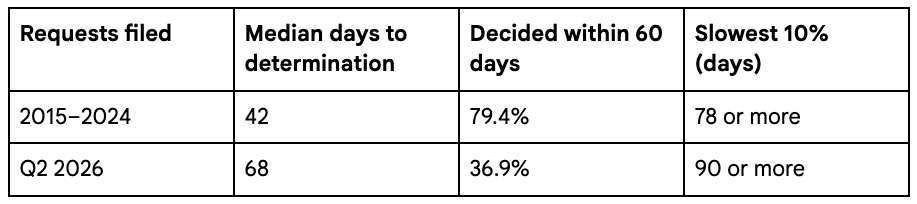
Determinations are now clustering against the statutory limit.
Meaninglessness of the Pre-Order Procedure: Among requests filed after April 5, 2026 that have had the full opportunity to respond, patent owners filed a pre-order paper in 109 of 274 (39.8%). But a change in grant rate hasn't been attributable to them; the CRU's denial rate has risen regardless of whether the owner filed a paper:
Requests filed before the procedure (January 2025 through April 4, 2026): 5.6% denied (53 of 948 decided).
Later requests with a patent-owner paper: 14.8% denied (22 of 149).
Later requests without one: 14.0% denied (25 of 178).
The similarity between the two post-procedure groups suggests the higher denial rate reflects a more demanding CRU review overall, not just the effect of individual pre-order papers.
Top Reexamination Requesters and Targets: Unified Patents (14 requests), Apple (12), Samsung affiliates (9, including Samsung Display's 4), and Google and Qualcomm (7 each) filed the most identified requests in Q3.
The most frequently targeted patent owners were Xiamen PVTech (7), Sonos (6) and Xueshan Technologies (6). The requester was not identified on 35 of the 198 Q3 requests (18%), up from 6% in the first half of the year.
PTAB Judges Deciding AIA Trials: The number of administrative patent judges (APJs) who sat on at least one AIA-trial panel with a decision fell to 100 in Q3 2026. That compares with 143 in Q3 2025 and a range of 135–176 per quarter from 2018 through 2025, and it matches Q3 2014 for the fewest in any quarter in over a decade. Falling caseload explains part of the decline, but not all of it:
In a typical quarter from 2019 through 2025, between 1 and 13 judges made their last appearance on a decided panel.
In Q4 2025 and Q1 2026 together, 39 judges did so. None of them have appeared on a decided panel in the six months since.
These figures measure judges deciding trials, not headcount; the PTAB reported roughly 230 APJs before 2025 and fewer than 200 by May 2025.
Filing Trends in PTAB by Entity Type: Owner-type classifications for 29 of the quarter's 106 petitions, mostly filed in August and September, had not yet loaded at pull time. Among classified Q3 petitions, operating-company patents (47) outnumbered NPE patents (29).
PTAB Petitions by Industry: High-tech patents drew 69 of 106 Q3 petitions (65.1%), within the range of recent quarters.
Filing Trends in High Tech at the PTAB by Entity Type: Among high-tech PTAB petitions with a classified owner in January–September 2026, 67.4% targeted NPE-owned patents, compared with 68.8% for the same period of 2025.
Top PTAB Petitioners: Samsung entities (19 petitions, counted once per case), Apple (16), and Google (13) were the most active PTAB petitioners in Q3, followed by Meta (9). The most frequently challenged patent owners were Headwater Research (9), Mobility IP Holdings (7), and Surecell Transactions, Ningde Amperex Technology (CATL), and Ricoh (6 each).
Filing Trends in District Court by Entity Type: NPEs filed 650 district court patent cases in Q3 2026, up 28.2% from Q2 and 55.7% of all cases (58.5% of cases with a classified plaintiff). Operating companies filed 459 cases. Unified classifies the firearms campaign discussed below — led by Rare Breed Triggers, which manufactures and sells the forced-reset triggers its patents cover — as operating-company litigation; 58 of the campaign's 99 Q3 cases carry that classification in our data, with the remainder awaiting reconciliation.
Top District Courts for Patent Litigation: The E.D. Tex. drew 400 cases (34.3%) in Q3, followed by the D. Del. (156), W.D. Tex. (76), D.N.J. (62) and N.D. Ill. (58). The W.D. Tex. total was its lowest in 2026, in the quarter when Judge Alan Albright's announced departure from the bench took effect.
Top District Courts for NPE Filings: The E.D. Tex. alone drew 349 NPE cases — 53.7% of the national total, matching the highest quarterly shares in our data going back to 2018 (53.3% in Q3 2024). Together, the W.D. Tex. and the W.D. Tex. accounted for 62.9% of NPE filings.
District Court Litigation by Industry: High-tech cases made up 49.6% of Q3 filings and medical/pharmaceutical cases 11.7%.
Filing Trends in High Tech in District Court by Entity Type: NPEs filed 87.7% of high-tech district court cases in Q3.
Over January–September 2026, 86.6% of NPE cases were high tech, against 11.5% of operating-company cases.
Top District Court Plaintiffs and Defendants: The affiliated plaintiffs Rare Breed Triggers, ABC IP and RBTM — one coordinated operating-company campaign in our classification, counted as distinct cases naming any of the three — filed 99 cases in Q3, just over half of them (51) in the E.D. Tex. They lead the plaintiff rankings for the second consecutive period, by more than two to one. The next most active plaintiffs were all NPEs: Near Field Electronics and Key Patent Innovations (34 each) and Valtrus Innovations (23).
The most frequently named defendants were Samsung (14), Apple (14) and Google (11). Generic-drug makers Cipla, Hetero Labs, Sun Pharmaceutical and Apotex (5–6 each) round out the list.¹
Unified Patent Court: UPC activity eased from its 2025 peak: 184 new first-instance and appeal actions in Q3 2026 (51 of them infringement actions), down from 193 in Q2 and 242 in Q3 2025, for 537 actions over January–September. Industry trackers report Düsseldorf overtaking Munich as the busiest local division during the period.
¹ USPTO Director John A. Squires appears as a named defendant in 17 district court cases filed in 2026. These are Administrative Procedure Act and mandamus challenges, not infringement actions, and are excluded from the defendant rankings.
Definitions
(Unchanged from the First Half 2026 report — Proceedings, Metrics, Entities, Sectors, Venues. Add:)
Pre-Order Paper = Under the USPTO's April 1, 2026 notice, a patent owner may file a paper of up to 30 pages, without a fee, within 30 days of service of an ex parte reexamination request filed on or after April 5, 2026, arguing that the request does not raise an SNQ.
SNQ Determination Deadline = 35 U.S.C. § 303(a) requires the Director to determine whether a request raises an SNQ within three months after the request is filed. Timeliness here is measured from the filing date the USPTO accords the request.
Active PTAB Judge = An administrative patent judge listed on a panel of three or more judges in a case with an institution decision or final written decision during the quarter. Director-issued summary denials, in which the Director is recorded as the sole decision-maker, are excluded.
Active CRU Examiner = The examiner of record on an ex parte reexamination with an SNQ determination (order or denial) or a closure during the quarter. Mirrors the Active PTAB Judge definition.
Methodology
This report includes all District Court, PTAB, ex parte reexamination and UPC cases from January 1, 2012 through September 30, 2026. We pulled the data on October 14, 2026.
The total number of reported cases can vary based on what is included. Unified made its best attempt to eliminate mistaken, duplicative, or changed-venue filings, so totals may vary slightly compared to other reporting entities. Statistics include litigation initiated by NPEs and declaratory judgment (DJ) actions initiated by operating companies against NPEs. Unified strives to identify NPEs accurately through all available means, including court filings, public documents, and product documentation.
Quarterly and half-year figures reflect Unified's data as of the pull date. Previously published figures can change:
Late-loading records.
USPTO re-dating of defective reexamination requests.
Entity reclassification.
Where a previously published figure has changed materially, it is listed under Errata below.
Entity-type classifications for the most recent weeks of filings load with a lag, so figures marked † are provisional: 29 of 106 Q3 PTAB petitions and 55 of 1,166 Q3 district court cases were not yet entity-typed at pull time, and percentages over classified cases are reported alongside totals.
The CRU docket counts a reexamination as open from its filing date until termination, certificate issuance, or other terminal status. About 300 pre-2017 records still marked pending but carrying no closing date are excluded, so levels before 2017 are a lower bound.
Institution rates follow our standing definition: institutions ÷ (institutions + denials) for decisions issued in the window. The SQL behind every figure is in the report folder of Unified's query repository, one file per figure.
Errata
First Half 2026 report — district court entity mix, Q2 2026. With later entity classifications, Q2 2026 now shows 507 NPE cases and 487 operating-company cases (50.2% NPE), compared with the 489 and 477 (48.6%) we published. The statement that Q2 2026 was the first quarter since Q1 2018 in which NPEs filed fewer than half of district court patent cases no longer holds.
First Half 2026 report — IPR institution rates by entity, Q2 2026. On current classifications, the Q2 2026 IPR institution rate was 50.0% for NPE-owned patents and 30.2% for operating-company patents, compared with the 47.0% and 35.6% we published. The direction of the reversal is unchanged.
First Half 2026 report — reexamination requests, Q2 2026. Q2 2026 now counts 331 requests, compared with the 336 we published, after the USPTO re-dated several defective requests. It remains the highest quarterly total on record, one filing above Q3 2012's 330.
2025 in Review — quarterly institution rates by entity. The quarterly rates in that report (for example, 53.2% for operating companies in Q4 2025) covered all PTAB trial types, IPR and PGR together. The quarterly entity chart in this report covers IPRs only. On current data, the Q4 2025 operating-company rate is 50.2% counting IPRs and PGRs together, or 46.9% for IPRs alone. The remaining difference from the published figure is consistent with later entity reclassifications. The NPE rate (33.6%) is unchanged on either basis.