PTAB Discretionary Denials Fall; Board Time Spent on Issue Rises

In 2021, in more than 45% of all IPR institution decisions (420 of 918), the PTAB spent considerable time and resources dealing with the discretionary considerations under the NHK Spring-Fintiv rule. But with more than a year since Director Iancu stepped down from the USPTO, Fintiv and 314(a) denials have plummeted dramatically. In Q1 of 2022, only 37 petitions have been denied on procedural grounds, and such denials on procedural grounds are projected to decrease by 17% year-over-year as seen below.

In particular, there have been only ten 314(a) denials in the first quarter of 2022. 314(a) denials are projected to decrease by roughly 2/3rds when compared to last year. Conversely, there is an uptick in 325(d) denials, with a projected increase of 83% when compared to last year.

In total, there have been only 32 denials based on either 314(a) or 325(d) so far in 2022. Collectively, these denials are expected to drop by 25% when compared to last year and will be the lowest since 2019.

Since Q1 of 2021, 314(a) denials have dropped every quarter, unlike 325(d) denials which have increased most of the time. 

When looking at all denials, 12.2% of denials were based on 314(a), while another 24% were other procedural-based denials.

Procedural denials that rely on 325(d) now occur 6.3% of the time.

When looking at 314(a) denial framework, interestingly General Plastic was the most used framework. NHK Spring/Fintiv based denials are projected to decrease by 85% in 2022. While the Board is spending more time addressing NHK Spring/Fintiv, these types of denials are becoming less and less common.

Looking overall, nearly 30% of all NHK Spring/Finitiv based denials since 2016 are NPE-based litigation.

The patent owners involved in NHK Spring/Fintiv based denials include both Operating Companies and NPEs. The top 10 patent owners involved in Fintiv denials account for 44% of all Fintiv denials. 4 of those patent owners are NPEs.

The Top-10 Fintiv denied petitioners encompass 63% of all Fintiv denials. Most of these companies are often targets of NPEs.

Taking this a step further, Unified examined specific cases where a party had filed a district court case against a party/parties and an unnamed defendant to the suit filed a petition at the PTAB with either the defendants named or on their own accord over the same patent. Since 2015 only 9% of all PTAB filings were from serial petitioners.

When a serial petitioner does file, 65.6% of the time it is against an NPE


© 2022 - Unified Patents, LLC - All Rights Reserved.

Prior art found on D3D Technologies patent

Unified is pleased to announce prior art has been found on U.S. Patent 10,795,457. The patent is owned by D3D Technologies, an NPE. The '457 patent generally relates to an interactive 3D cursor facilitates selection and manipulation of a three-dimensional volume from any three-dimensional image. The ‘457 patent has been asserted against Microsoft.

We would also like to thank the dozens of other high-quality submissions that were made on this patent. The ongoing contests are open to anyone, and include tens of thousands of dollars in rewards available for helping the industry to challenge NPE patents of questionable validity by finding and submitting prior art in the contests. Visit PATROLL today to learn more about how to participate.

WINNING SUBMISSION

$2,000 awarded for Acacia subsidiary prior art

Unified is pleased to announce PATROLL crowdsourcing contest winners, Vibhor Dimri and Nikko Quevada, who split a cash prize of $2,000 for their prior art submissions for U.S. Patent 7,224,678. The patent is owned by Stingray IP Solutions, LLC, a subsidiary of Acacia Research Group, an NPE.

The '678 patent generally relates to wireless LAN with intrusion detection features. It has been asserted against TP-Link Technologies, Signify, and Samsung in the Eastern District of Texas.

We would also like to thank the dozens of other high-quality submissions that were made on this patent. The ongoing contests are open to anyone, and include tens of thousands of dollars in rewards available for helping the industry to challenge NPE patents of questionable validity by finding and submitting prior art in the contests. Visit PATROLL today to learn more about how to participate.

WINNING SUBMISSION

Tracking Innovation: Using Unified’s Portfolio Velocity Tool

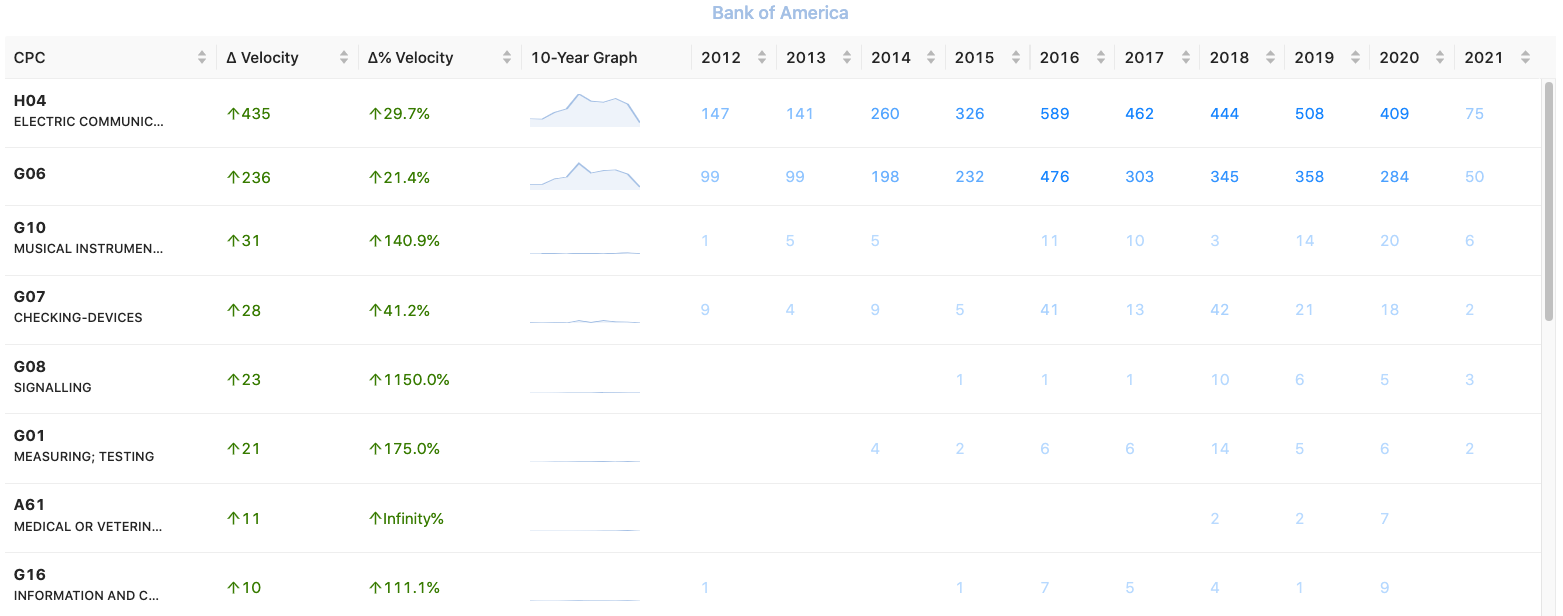
Unified’s Portal has added a new component to its Portfolio analysis tab that allows companies to be compared in terms of accelerated or decelerated innovation based on CPC codes.

Innovation Velocity uses two key metrics: ▲ Velocity - the total sum of patents per class code within the last 10 years; and ▲% Velocity - the percentage of change over a given time period. The Innovation Velocity formula is:


The Final Number of Patents specifically looks at years 2017-2022, while the Initial Number of Patents looks at years 2012-2022. By using these parameters, the tool is able to overcome the natural “dark period” of time within the U.S. patenting process. The dark period refers to the 18 months from which an application is filed to the day it is published. These 18 months make it extremely difficult to understand a portfolio’s trajectory because naturally there will be a decline in publicly available application/patent information. By using the formula, the most recent years are aggregated together to get a holistic view of the number of patents over a given time period and measured against the previous years. This provides a glimpse to either the growth or the decline in a specific classification code.

As an example, we can compare Bank of America’s portfolio against JP Morgan Chase in terms of patenting trends, The Innovation Velocity tool allows users to see the general patenting trends for the top CPC codes, with the total being aggregated. Included are the CPC, ▲ Velocity, ▲% Velocity and a ten year graph to show the general trend.

Users then can see the number of patents granted, within each CPC, on the timeline over a specific time period. The patent count is hyperlinked back to Portal’s Patent Search where more analysis could be done on the set of patents.

Users can also view the macro trends of a company, but looking at all the top CPCs and see an aggregate total for the entire company.

Since CPCs tend to be generic and broad, Unified’s Portal provides the same analysis on the CPC Subclass.

Innovation Velocity not only helps companies understand their specific portfolio, but this tool allows users to compare their portfolio with others to understand both the macro and micro trends of their patenting strategy.

Dominion Harbor entity Liberty Peak Ventures patent likely invalid

On April 26, 2022, the Patent Trial and Appeal Board (PTAB) instituted trial on all challenged claims in an IPR filed by Unified against U.S. Patent 8,066,181, owned and asserted by Liberty Peak Ventures, LLC, a Dominion Harbor entity. The '181 patent relates to generating an authentication tag for use in contactless transactions and has been asserted against Citigroup.

View district court litigations by Liberty Peak Ventures. To read the petition and view the case record, see Unified’s Portal. Unified is represented by in-house counsel Michelle Aspen and Roshan Mansinghani.