Overview
With patent reform clearly on the horizon, as three different bills were introduced this past month, patent disputes still show no signs of slowing down. In fact as Senator Patrick Leahy introduced the Restoring the America Invents Act to address the uncertainty with Fintiv, reexaminations have made a significant comeback and are expected to continue to grow by 33%. This comes on the heels of much uncertainty in 2021 with the pandemic still ongoing, the critical Arthrex decision, and several proposed changes to the patent system. Other factors, such as Qualcomm leaving Velos, could signal a new wave of litigation related to video codecs with a fractional pool approach. Despite the uncertainty this year, the constant variable has been NPEs continually asserting low quality patents against start-ups, small businesses, and manufacturers that are vital for economic recovery and growth.
Highlights:
Despite Judge Albright's Eleventh Abuse of Discretion on Transfers on Mandamus, TXWD leads other district courts in accounting for nearly 25% of all patent cases. NPE-related litigation accounts for 72% of the patent cases in this district.
NPE-related litigation continues to drive the total number of cases, as 60% of all cases stem from an NPE.
Even with the slight dip in PTAB filings, Fintiv still remains a challenge as 77 denials have been issued under this framework, nearly matching last year's total of 85.
Reexaminations have matched last year totals and are expected to increase by 33% to nearly 300 filings.
Access Advance has poached significant HEVC portfolios, such as Panasonic's patents, from its competitors and shown that it is backed by effective litigation. This can only spur licensing and litigation efforts as Access Advance will have to deliver for its new licensors. It is easy to speculate that pools like Velos will have to follow suit if they wish to remain in the market. Qualcomm's recent exit from Velos however doesn't help.
Unified is the 6th overall filer with 237. This year alone Unified has filed 23 reexaminations and 17 Chinese oppositions, in addition to the 7 EPO oppositions, 1 UK opposition and 5 Japanese oppositions from last year.
Figure 1: As 2021 begins the final quarter, it would appear business as usual despite the Covid Pandemic continuing. Litigation appears to be following its normal average since 2017, with a projected amount of 3,675 for the entire year. In addition, despite the earlier uncertainty around Arthrex and Fintiv, the PTAB will see over 1,300 filings for the entire year. Reexaminations have already matched last year’s total and are expected to increase by 33%
Figure 2: Reexaminations have more than doubled since the third quarter of 2020, making up for any decline that can be seen in litigation and PTAB filings.
Figure 3: Despite Judge Albright's Eleventh Abuse of Discretion on Transfers on Mandamus, TXWD leads other district courts in accounting for nearly 25% of all patent cases. NPE-related litigation accounts for 72% of the patent cases in this district and almost surpasses the total number of patent cases filed in the District Court of Delaware. View all District Court and PTAB litigation on Unified’s Portal.
Figure 4: High-Tech litigation continues to dominate both district courts and the PTAB, respectively.
District Court
Figure 5: NPE-related litigations are projected to out-pace last year’s numbers by 2.4%, while operating companies have shifted focus on post-pandemic recovery. However, the increase in NPE-related litigation seems to put litigation on par with the last couple of years.
Figure 6: Looking quarter-by-quarter, NPE-related litigation continues to remain at its 5-year average of 59%.
Figure 7: Cedar Lane Technologies is the highest asserting entity in 2021. Following previous trends, 9 of the top-10 named asserting entities in 2021 were NPEs. View District Court litigation on Unified’s Portal.
Figure 8: Samsung entities were the most targeted first-name defendants in 2021. Litigation seems to be centered on network, computer, wireless, and cellular manufacturers. View District Court litigation on Unified’s Portal.
Figure 9: In the first half of 2021, 70.5% of all new US district court patent cases involve High-Tech companies. This is up 5% from last year.
Figure 10: NPE activity in the High-Tech sector alone continues to contribute more 2021 patent infringement cases than all non-NPE patent litigation combined. NPEs target the High-Tech sector 95% of the time. View High-Tech litigation on Unified’s Portal.
Figure 11: NPEs accounted for 87% of assertions in High-Tech Litigation in 2021. View all 2021 District Court litigation on Unified’s Portal.
PTAB Disputes
Figure 12: Based on the second quarter of 2021, PTAB filings are projected to decrease by 13% this year. This is most likely due to the combination of companies turning to re-examinations and the uncertainty of discretionary denials. The Board’s institution rate in inter partes reviews has increased and is now at 57.7%. More details for these PTAB proceedings are available on Unified’s Portal.
Figure 13: This quarter, the PTAB received a total of 311 requests for inter partes reviews, down 11.14% from the second quarter of 2021. NPE related-filings accounted for 36% of all filings.
Figure 14: Consistent with district court proceedings, approximately 66.9% of petitions filed in 2021 involved High-Tech companies.
Figure 15: Approximately 54% of all AIA challenges filed in 2021 that involved High-Tech companies related to NPE-controlled patents. Explore this data further on Unified’s Portal.
Figure 16: IPRs remained the most popular post-grant proceeding at the PTAB. However, reexaminations account for 17.7% of all patent challenges at the USPTO, an 3% increase from last quarter. Explore this data further on Unified’s Portal.
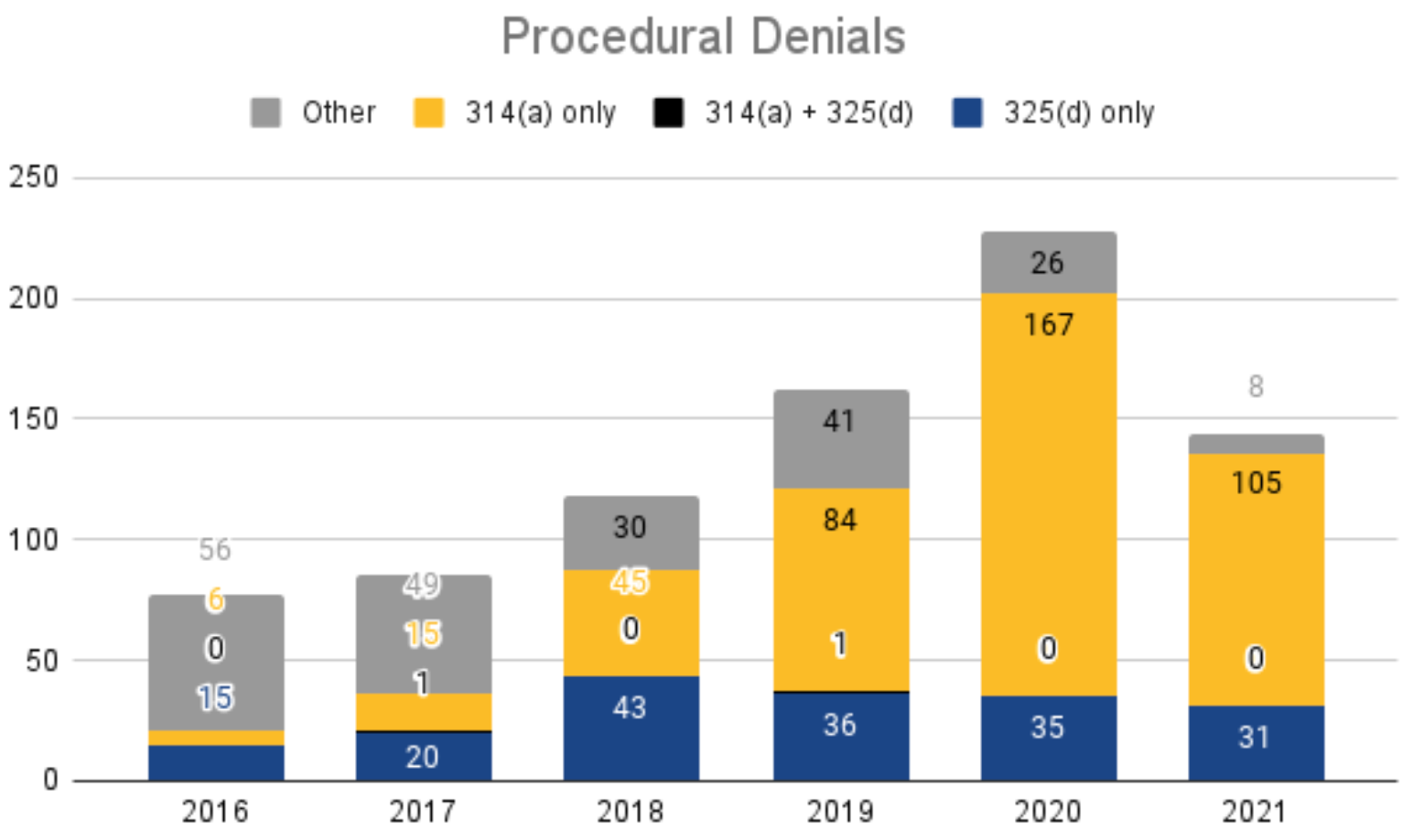
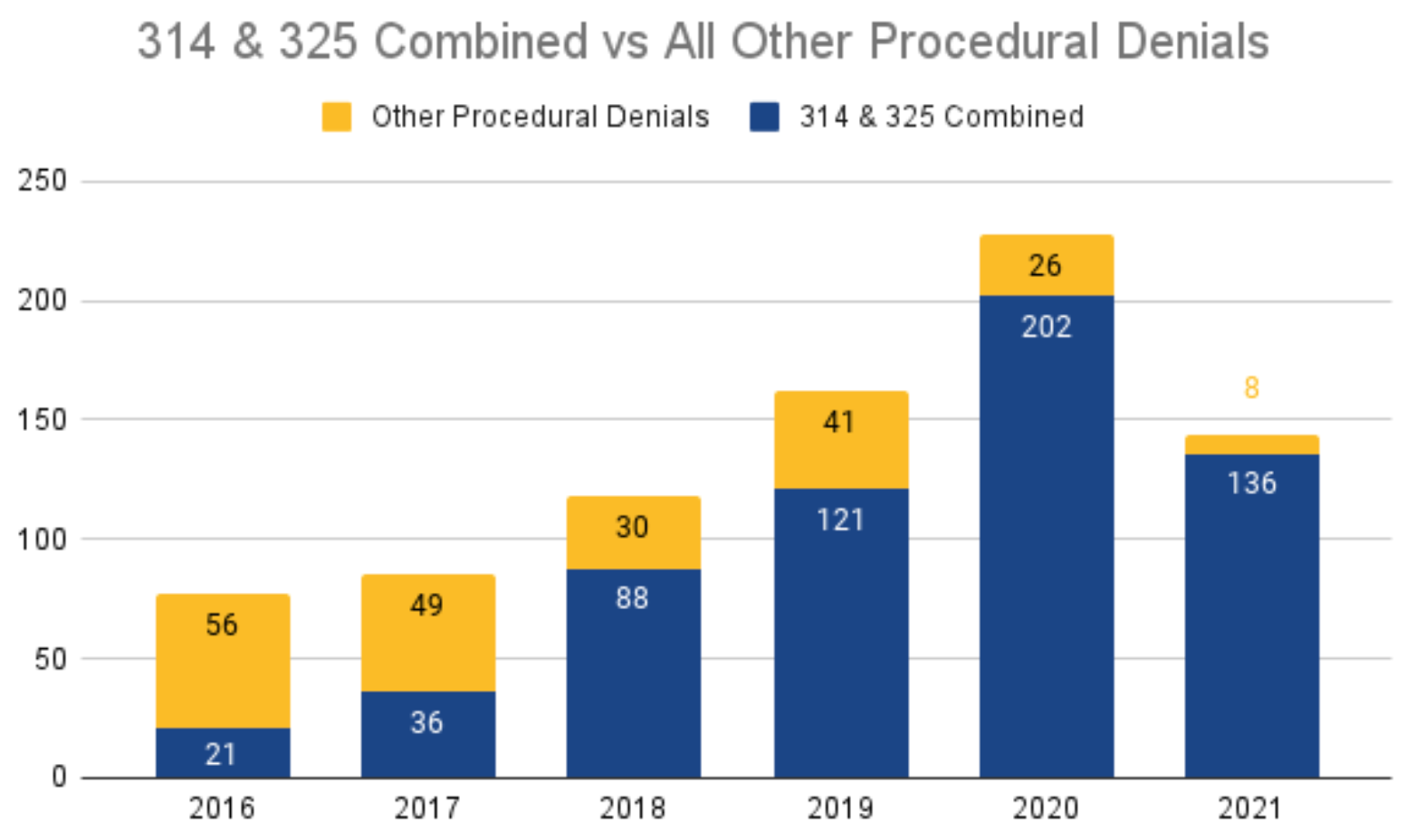
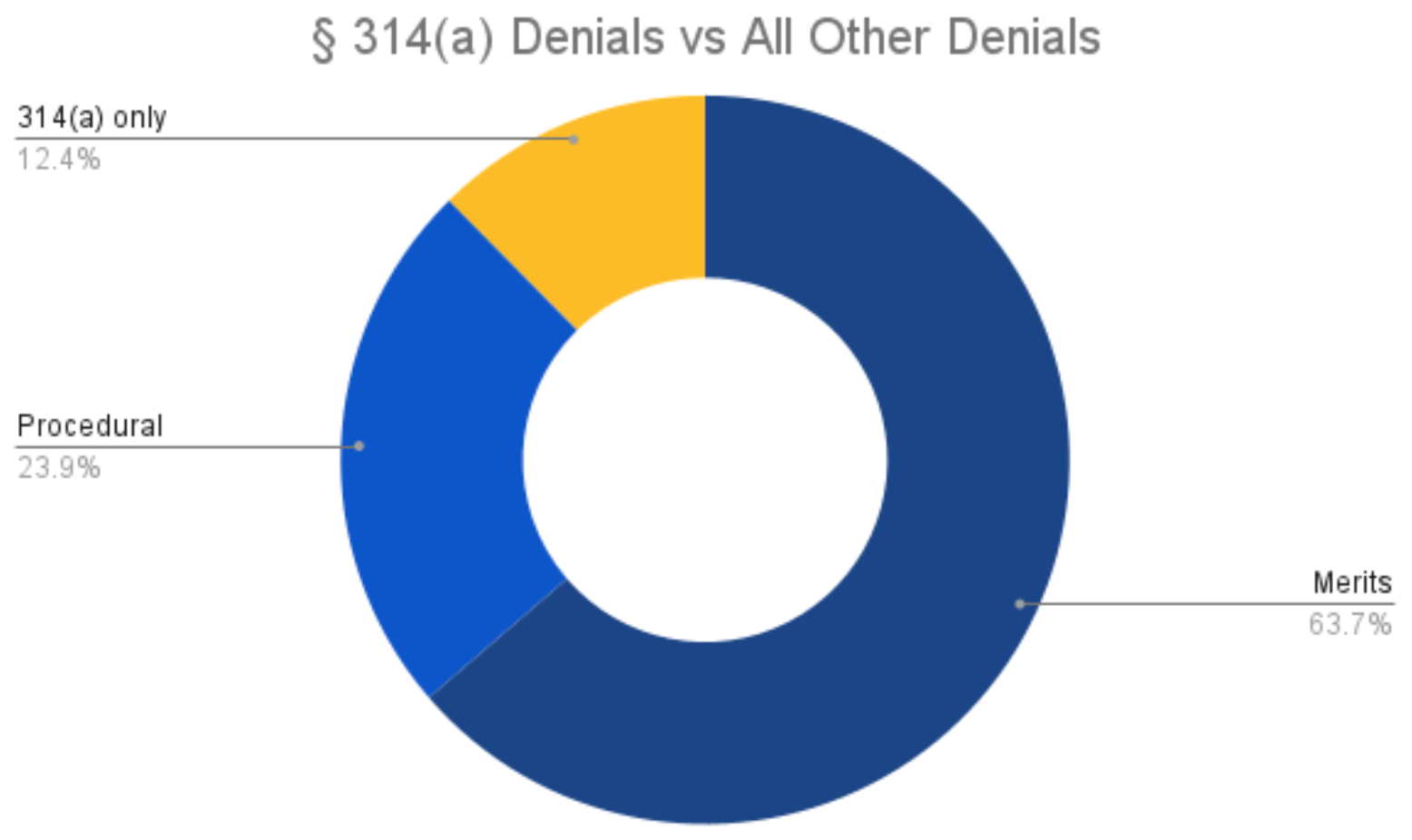
Figure 17: As of September 10, 2021 a total of 105 decisions were made on the basis 314(a) and 31 decisions were made on the basis of 325(a). The 105 314(a) denials accounts for 73% of all denials. That is, compared to 2019 in total, no change—in 2019, 314(a) denials accounted for roughly 73% as well.

Figure 18: NHK Spring/Fintiv continues to be the dominant framework of 314(a) denials. This year has seen 77, nearly reaching the previous-year high of 85. NHK Spring/Fitniv accounts for 73% of all 314(a), whereas in 2020 only 51% were based on the Fintiv framework. This is a 23% increase from last year. More details will follow in the Unified quarterly report on discretionary denials.

Figure 19: The first half saw Samsung as the most frequent petitioner with 90. Unified, is the 6th overall filer with 237. This year alone Unified has filed 23 reexaminations and 17 Chinese oppositions, in addition to the 7 EPO oppositions, 1 UK opposition and 5 Japanese Oppositions from last year. View all of Unified’s cases on Unified’s Portal.
Figure 20: Breaking from previous years there is now a focus on challenging operating companies, rather than NPEs at the PTAB, as only 4 of the top 10 Patent Owners are NPEs. View all PTAB cases on the Portal.
Reexaminations
Figure 21: Reexaminations continue to increase. This year has already matched last year’s totals, with an expected increase of 33% to 292 for the year. View all reexaminations of Portal.
Standard Essential Patents
Figure 22: Competing HEVC pools are poaching each other's licensors by offering better monetization - ie, more aggressive licensing and litigation. HEVC has already seen a fair number of cross-pool poaching over the last year, with Panasonic's side-step from Velos to Advance being the most recent. Indeed, Velos and MPEG LA are shedding major licensors which in turn is weakening their attractiveness towards licensees and licensors alike - the downward spiral in value is inevitable. Panasonic's side-step is a harbinger of worse things to come for Velos. On September 23rd, per the USPTO, Velos Media LLC transferred 51 coding patent assets to Qualcomm. Shortly thereafter, Qualcomm announced that it was leaving Velos and had no immediate plans to join another pool. At Velos' height, around 15% of Velos' pooled patents was attributed to Qualcomm. This signals a significant decrease in Velos' ability to monetize its licensors' portfolios and also increases the pressure on Advanced to deliver for its newly poached licensors. View Unified Consulting assessment on HEVC and VVC.
Figure 23: Unified Patents recently produced an independent economic study on VVC’s licensing value as a follow up to its 2019 study on the licensing value of HEVC. The study points out that “[f]or VVC to capture market share among cellular device manufacturers, [its] royalty rates will have to be very attractive compared to the rates for AVC and AV1.” VVC is entering a fragmented, multi-codec market and its adoption is uncertain in the face of competitive video solutions that are subject to lower or no royalties. Much of this is due to the excessive royalties and licensing uncertainties that continue to plague VVC’s predecessor, HEVC.

Definitions
Sectors
High-Tech = Technologies relating to Software, Hardware, and Networking
Medical = Technologies relating to Pharmaceuticals, Medical Devices, Health Related Technologies
Other = Technologies relating to Mechanical, Packaged Goods, Sporting Equipment and any other area outside of high-tech and medical patents.
Entities
Non Practicing Entity (NPE) = Company which derives the majority of its total revenue from Patent Licensing activities.
Operating Company or Op. Co. = Company which derives most of its total revenue from Product Sales or Services. Could be an SME or a large company.
Other Entity = Universities / Non-Profits / Government / Non-Governmental Organizations (NGOs)
NPE (Patent Assertion Entities) = Entity whose primary activity is licensing patents and acquired most of its patents from another entity
NPE (Small Company) = Entity whose original activity was providing products and services, but now is primarily focused on monetizing its own patent portfolio.
NPE (Individual) = Entity owned or controlled by an individual inventor who is primarily focused on monetizing inventions patents by that individual inventor.
Venues
CACD = Central District of California
CAND = Northern District of California
DED = Delaware
NJD = New Jersey
NDIL = Northern District of Illinois
SDNY = Southern District of New York
TXED = Eastern District of Texas
TXWD = Western District of Texas
Methodology
This report includes all District Court, PTAB, and Reexaminations litigations between January 1, 2015 and September 30, 2021.
Total number of reported cases can vary based on what is included. Unified made its best attempt to eliminate mistaken, duplicative, or changes in venue filings, hence the totals may vary slightly compared to other reporting entities. Statistics include litigations initiated by NPEs or Declaratory Judgments (DJs) initiated by operating companies against NPEs.
Unified strives to accurately identify NPEs through all available means, such as court filings, public documents, and product documentation.