

As part of its ongoing deterrence efforts, Unified Patents continues to track and report on Third-party Litigation Funding (TPLF), providing greater transparency into this growing yet still poorly understood segment of the patent litigation landscape. Below is the abstract and key takeaways from a recently published article by Korok Ray and his team at Texas A&M University. This independent academic work, grounded in Unified’s data, validates the core of our TPLF advocacy. It is available for download on SSRN HERE.
ABSTRACT
U.S. patent litigation has come to rely on third-party litigation funding (TPLF), which involves an external investor providing funds to pay for a lawsuit or a law firm in return for its share of any recovery. This paper uses a litigation dataset spanning January 2010 through June 2026 to examine the growth of identified TPLF, its concentration across federal patent venues, the role of non-practicing entities, and the policy implications of uneven disclosure requirements. The data show a long-run increase in identified funding, with TPLF reaching roughly one quarter of filings in the most recent period, alongside a renewed concentration of patent litigation in the Eastern District of Texas and a decline in Delaware following the adoption of heightened disclosure requirements. The paper also examines how changes in inter partes review practice alter the litigation environment in which patent owners, defendants, and funders operate, and evaluates competing approaches to TPLF regulation, including case-by-case disclosure, a uniform federal disclosure rule, targeted legislation, and prohibition. It concludes that a uniform disclosure framework is preferable to the current court-by-court patchwork, while distinguishing disclosure of funder identity and control rights from automatic production of all economically sensitive funding terms.
Key Takeaways:
Funded entities are now driving one in four patent filings. The TPLF share rose from 5.77% (2010–2012) to 11.36% (2017–2020), 20.45% (2021–2024), and 25.43% in 2025.
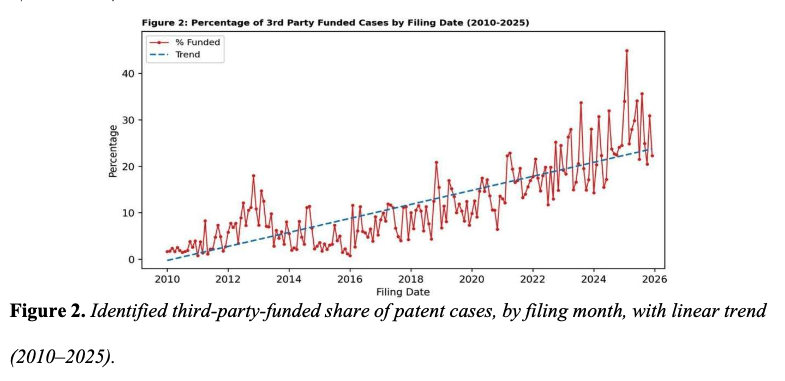
TPLF-backed plaintiffs are avoiding courts that require disclosure. Delaware's share of patent cases fell from 22.2% (2017–2020) to 11.1% (2025) after Judge Connolly's April 2022 funding order, while E.D. Tex.—no disclosure rule—climbed to 29.1%.
NPEs are continuing to make up the lions-share of patent litigations. NPEs now account for roughly 54% of cases, up from about 47% in the 2000–2021 study. Uniloc entities alone account for 1,079 cases.
PTAB changes may fuel more funding. IPR petitions fell from 698 (1H 2025) to 174 (1H 2026). Monthly institution dropped from 81.8% to as low as 19.4%, and NPE-owned patents are instituted at 27.2% vs. 41.4% for operating companies. The authors identify three channels for further TPLF growth: less invalidation risk for funded campaigns, shifted settlement leverage, and older portfolios becoming more attractive to acquire.
To read more, download on SSRN HERE.