
Analog NPE Litigation Skyrockets

Non-practicing entity (NPE) litigation against semiconductor companies—particularly analog chips—has grown significantly in the past few years, as their value in all types of products has increased.   And while much attention is given in the semiconductor industry to CPUs and GPUs (which handle the most complex tasks), NPEs have increasingly focused on analog chips, which Unified classified as low-power or high-power audio or radio frequency applications that support many functions.  With easier (and broader) infringement profiles and a proliferation of patents available on the open market, it’s no surprise that the NPE industry has shifted their attention to the more easily-enforceable (and more likely invalid) analog sector. 

Over the last year, semiconductor and supply chain shortages have made headlines.  Both have led to inflation and raised concerns about economic corrections.  Chip shortages have been blamed for many of the supply chain issues, as they are necessary for so many different products now, from lightbulbs to automobiles.  Though most would assume complex chips drive the shortages, in truth many of the supply chain issues are the result of analog chips.  That, coupled with the relative ease of proving infringement and the ready availability of patents to license, has led NPEs to focus more resources on asserting against the analog industry. 

For instance, Atlantic IP, a Magnetar Capital-funded managing entity based in Ireland, has several subsidiaries currently engaging in high-stakes funded litigation. Neodron, Scramoge Technology, Sonraí Memory, Arigna, and Solas (to name a few of their ongoing campaigns) currently have nearly 3,000 assets to their name, and started asserting them in various high-profile litigation campaigns. 

Indeed, nearly 87% of all recent analog semiconductor litigation has come from PAEs. 
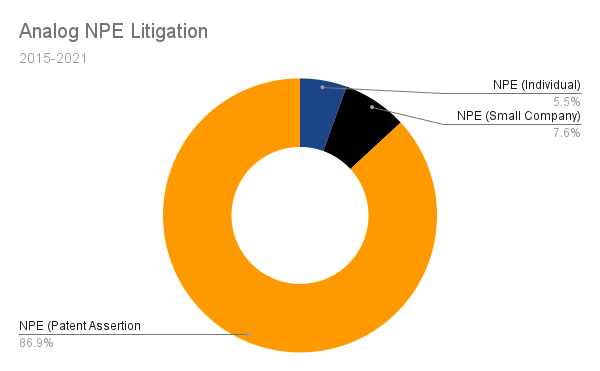
The explosive growth of patent aggregators has led directly to the explosion of suits. Indeed, nearly 40% of all of this litigation is driven from larger aggregators like Atlantic IP. 

What’s more, over 36% of these aggregators have third-party financing supporting their assertions.

To put this issue in perspective, the top-20 plaintiffs—the frequent filers and notorious aggregators—account for nearly 60% of all analog semiconductor cases.

That said, there are a surprising number of smaller campaigns being filed against analog chips, cases both big and small in licensing target—some from file-and-settle nuisance NPEs like IP Edge, others from slightly more serious lawyer-run entities looking for a quick payday with a 101-resistant portfolio. Either way, it appears that investors and assertors alike see much value in assertions in the analog semiconductor space.


Copyright © 2022, Unified Patents, LLC. All rights reserved.

PTAB Procedural Decisions Report: Non-Merits Based Decisions Rise, Denials Fall

It was another year of hundreds of procedural denials at the PTAB, as the Board ruled on Fintiv and discretionary issues in almost half of all decisions. The dip in the number of discretionary denials in 2021 from 2020’s record high likely reflects parties adjusting to the recent requirements by filing so-called Sotera stipulations, devoting petition space to briefing the Fintiv factors, and shifting to file ex parte reexaminations over IPRs (which increased by half, as shown below). 

And while grants were down and it is difficult to measure how much time, money, and efforts have been expended responding to Fintiv, data shows the Board considered discretionary issues in approximately 500 of the institution decisions issued in 2021, or roughly more than a third of all the 1,249 decisions it made. In short, Fintiv affected almost half the cases on the Board’s docket in 2021. 

2021 saw 179 institution decisions denied on procedural grounds, compared to 228 in 2020 and 162 in 2019. 

Of institution decisions issued in 2021, the Board used Section 314(a) 123 times to dodge the merits and deny the petition. 

When combining Section 314(a) denials with Section 325(d) denials, this number again was down slightly from 2020.

With Director Iancu stepping down at the beginning of the Biden administration and caretaker leadership currently in place at the USPTO until a new director is confirmed, an interesting story emerges when examining the quarter-by-quarter data. A quarter-by-quarter analysis shows that procedural denials were at a high in the first half of 2021, falling off over the second half as petitioners adjusted to Fintiv by filing Sotera stipulations, dedicating larger portions of their petition to Fintiv issues, or simply opting to file reexams. After the high, the Board’s overall use of 314(a) to discretionarily deny petitions has dropped slightly. However, the trend of discretionary denials under 314(a) related to expensive ITC proceedings and faulty stipulations continued unabated, and discretionary denials under Section 325(d) have been on the rise in recent months.  Ultimately, there was a 73% decrease from the first quarter of 2021 to the last quarter of 2021. Whether that is a combination of parties getting savvier about Sotera stipulations and Fintiv briefing and the lack of further precedential efforts in the area, or more reflective of a longer-term trend, remains to be seen—but with 40% of petitions addressing the issue this year, Fintiv has become omnipresent and shows no signs of stopping. 2022 looks set to exceed last year’s numbers as January already has 18 discretionary denials.

What is clear is that discretionary considerations continue to make up a substantial portion of the Board’s overall institution decision docket, and as a result, they eat up a fair number of pages, additional briefing, and party and Board time. These are pages and time that could be spent on addressing the merits of a challenge, rather than used to jump through procedural hoops that are outside the boundaries of the IPR statute. 
Section 314(a) denials are now used by the Board nearly 12.4% of the time.

Meanwhile, Section 325(d) denials remain consistent at 5.9%. Note that all 325(d) denials are statutory—i.e., the express considerations are outlined in the statute, rather than reflected in a series of Board decisions interpreting the Board’s authority—so there is no need to further subdivide the category.

The NHK Spring/Fintiv framework, in particular, remained consistent with last year, while Parallel Petition Denials decreased by 75%—suggesting that most parties are simply avoiding filing multiple petitions on the same patent, regardless of length of claims, need, or space issues. These changes could be indicative of future changes to come at the PTAB, or they could represent parties changing their filing behaviors to avoid what they now see as a stumbling block for all petitions.

Over the same period, companies began to revive ex parte reexaminations–an old, but nonetheless effective, tool. From 2020 to 2021, the number of reexaminations increased by 47%. Over 300 reexaminations were filed in 2021, as parties occasionally forwent IPRs that raised discretionary or stay-related issues.


Copyright © 2022, Unified Patents, LLC. All rights reserved.

$12,000 for Atlantic IP Services sub, Speir Technologies, prior art

On January 28, 2022, Unified added 6 new PATROLL contests, with a $2,000 cash prize for each, seeking prior art on the list below. The patents are owned by Speir Technologies, an Atlantic IP Services subsidiary. The contests will all end on May 31, 2022. Please visit PATROLL for more information or click on each link below.

We also have third-party prior art providers giving our researchers a head start in the hunt! Click on each of the contests to find more from Traindex.io, Techson IP, IPscreener, Ambercite, and Google Patent Analytics.

Velos '086 patent successfully challenged

On January 27, 2022, less than a year after Unified filed its request for ex parte reexamination, the USPTO issued a final office action rejecting all challenged claims of U.S. Patent 9,743,086, owned by Velos Media. The '086 patent was purportedly essential to the HEVC standard. During reexamination, to overcome the rejections, Velos was forced to greatly amend the claims of the '086 patent such that they are no longer essential.

Unified is represented by David Cavanaugh, Scott Bertulli, Brian Lambson, and Jonathan Knight from WilmerHale and by in-house counsel, Ashraf Fawzy and Jessica L.A. Marks, in this proceeding. To view any documents for the reexamination proceedings on Unified's Portal, go to https://portal.unifiedpatents.com/exparte/90014637.

$18,000 for Dominion Harbor sub, Redwood Technologies, prior art

On January 28, 2022, Unified added 9 new PATROLL contests, with a $2,000 cash prize for each, seeking prior art on the list below. The patents are owned by Redwood Technologies, LLC, an NPE and entity of the Dominion Harbor Group. The contests will all end on May 31, 2022. Please visit PATROLL for more information or click on each link below.

We also have third-party prior art providers giving our researchers a head start in the hunt! Click on each of the contests to find more from Traindex.io, Techson IP, IPscreener, Ambercite, and Google Patent Analytics.