
$2,500 for prior art on IP Edge subsidiary, Dedicated Licensing

On June 29, 2021, Unified Patents added a new PATROLL contest, with a $2,500 cash prize, seeking prior art on at least claim 1 of U.S. Patent 9,397,627. The patent is owned by Dedicated Licensing, LLC, an NPE and IP Edge subsidiary. The '627 patent generally relates to a network-enabled audio device that provides a display device that allows the user to select playlists of music much like a jukebox. It is currently being asserted against Rhapsody, Vimeo, iHeartMedia, SoundCloud, Sound Hound, and Genius Media Group.

The contest will expire on October 15, 2021. Please visit PATROLL for more information and to submit an entry for this contest.

Prior Art ProviderClaim Chart Link
Apex StandardsPseudo Claim Charting
Techson IPLimestone|Report
Amplified Invalidity Report
Traindex Prior Art Report
InQuartik Semantic Prior Art
IPscreener Relevant Prior Art
Google Similar Documents - NPL
Google Similar Documents - Patents
Unified Portal Relevant Prior Art

AutoBrilliance patent held unpatentable

On July 6, 2021, the Patent Trial and Appeal Board (PTAB) issued a final written decision in Unified Patents, LLC v. Autobrilliance, LLC, holding all challenged claims (claims 1, 2, and 4-7) of U.S. Patent 6,792,351 unpatentable. The ‘351 patent, directed to multi-vehicle communication, had been asserted in district court litigation against Toyota.

View AutoBrilliance's district court litigation. To read the petition and view the case record, see Unified's Portal. Unified was represented by Raghav Bajaj and David McCombs at Haynes and Boone, and by in-house counsel, Alyssa Holtslander, Roshan Mansinghani, Jess Marks, and Jung Hahm, in this proceeding.

Flexiworld Technologies reexamination request granted

On May 11, 2021, 4 weeks after Unified filed an ex parte reexamination, the USPTO granted Unified’s request, finding substantial new questions of patentability on the challenged claims of U.S. Patent 10,346,114, owned by Flexiworld Technologies, Inc. The ‘114 patent relates to transmitting or streaming protected digital content to client devices over the internet. It has been asserted against Roku.

View district court litigations by Flexiworld. Unified is represented by Wilson Sonsini and by in-house counsel, Ashraf Fawzy and David Seastrunk.

To view any documents for the reexamination proceedings on PAIR, go to https://portal.uspto.gov/pair/PublicPair, enter 90/014,721, and click on the "Image File Wrapper" tab.

WSOU '213 patent challenged

On July 1, 2021, Unified Patents filed an ex parte reexamination against U.S. Patent 8,103,213. Formerly owned by the Nokia Corporation, the ‘213 patent is currently owned by WSOU Investments, LLC and has been asserted against NEC in the Western District of Texas.

Unified is represented by Eric Buresh and Chris Schmidt from Erise IP and by in-house counsel, Ashraf Fawzy and Jung Hahm, in this proceeding.

To view any documents for the reexamination proceedings on PAIR, go to https://portal.uspto.gov/pair/PublicPair, enter 90/014,789, and click on the "Image File Wrapper" tab.

USPTO on Pace to Again Issue 200+ Discretionary Denials in 2021

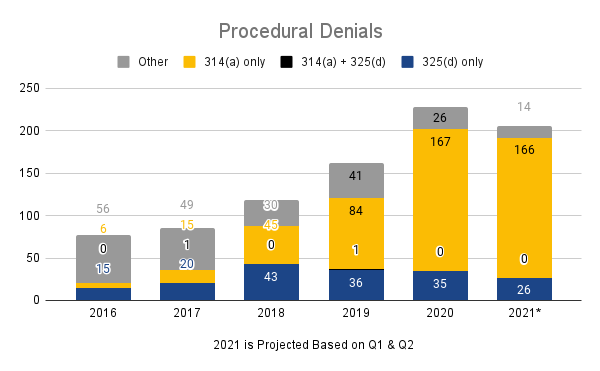
Even as Athrex was looming in the background, the PTAB has still managed to deny 104 petitions on procedural ground thus far in 2021. What is interesting, though, is the first quarter saw a combined total of 74 denials on procedural ground, while the second quarter saw a dip, to 30. As projected, discretionary denials are on pace to be just slightly lower in 2021 than in 2020 overall—and that is with more institution decisions in general set to issue.

Institutions Decisions (3).png

Despite the dip in procedural denials, § 314(a)—and among that, generally, Fintiv-related denials—is still projected to account for 80% of all procedural denials.

Procedural Denials (4).png

This trend can be seen further below, with 92% of denials being based on either § 314(a) or § 325(d) denials.

314 & 325 Combined vs All Other Procedural Denials (3).png

Section 314(a) denials are now used by the Board roughly 12.2% of the time, an 0.1% increase from last quarter.

§ 314(a) Denials vs All Other Denials (3).png

Meanwhile, 325(d) denials continue to fall in line with the previous years, and were used only around 5% of the time.

§ 325(d) Denials vs All Other Denials (5).png

NHK Spring/Fintiv framework is expected to continue to grow as a percentage of reasoning, with it representing nearly 40% of all denials this year; indeed, the reasoning accounts for 71% of § 314(a) denials.

314(a) Denials By Type (5).png

Interestingly, as previously mentioned in the first quarter report of 2021, the Western District of Texas was projected to see a slight bump in denying petitions using the NHK Spring/Fintiv framework when the patent in question is being disputed in that jurisdiction. Now it would seem like there is a slight decrease in the WDTX, whether from lack of filing attempts, or from the speed of settlement there.

NHK Spring_Fintiv Denials with District Court Cases (2).png

Although the WDTX is now seeing a fourth of all patent disputes nationwide (See Q2 2021 Patent Dispute Report), the Eastern District of Texas is, as of the first half of this year at least, seeing 40% of all NHK Spring/Fintiv denials—up 2% from the previous quarter. The WDTX remains relatively the same seeing a slight decrease of .7%. That is without controlling for speed of settlement or rate of PTAB filings in active cases.

Use of NHK Spring_Fintiv Denials with District Court Litigation (2).png

That said, the speed of resolution in patent cases across all districts has risen substantially, even as COVID restrictions have begun to lift; the significant backlog is, rather than dissipating, apparently increasing time-to-resolution across the country. 

Compared to last quarter, every district has increased their length to termination. The District of Massachusetts time-to-termination has increased by nearly two months, and the WDTX’s has increased by almost a month, even including the unusually high rate of quick settlement there.

Months to Termination in District Court (3).png

That said, the time-to-trial in the Western District of Texas’ Waco division is 20.48 months (in the mere 20 trials Judge Albright has presided over date); for the seven patent cases he has held, the average time-to-trial is a few days under two years, or 24 months—roughly five months beyond the ambitious target his scheduling orders set. Source: Lex Machina Database (Updated Jul. 6, 2021). The early termination averages in the Western District are driven primarily by hundreds of quick settlements.