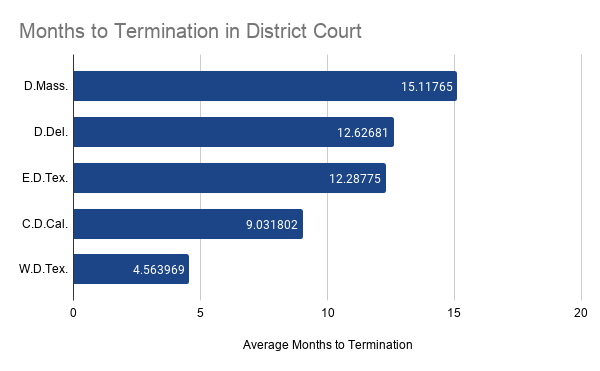
Of substantive note is the trend of denial decisions ignoring increasingly overwhelming evidence that the trial dates parties base their Fintiv arguments on are entirely illusory or, at best, highly aspirational—both case-specific and court-generalized data tends to be ignored for whatever is listed in a court’s standing order. The Western District of Texas, for instance, has never even come close to meeting the trial dates listed in their standing order; the Eastern District of Texas (particularly this and last year, after outbreaks and closures related to COVID) is laboring under a growing backlog and does not appear to be set to meet or exceed trial date expectations any time soon.
In one recent example, Nine Energy Service Inc. v. NCS Multistage Inc., IPR2020-01615, the Board declined to take up the merits based on a standing order-scheduled October trial date in the Western District of Texas (in March), despite both general evidence that that Court has never hit their aggressive target scheduled trial date before (and in 2020 increased their time-to-trial delay by 5 months on average) and specific evidence that the case would almost certainly be consolidated and moved back to accord with later-filed actions among the same parties. The patent, a relatively recently issued patent on fracking technologies, U.S. 10,465,445, had not been challenged previously.
When looking at 2019 through the first quarter of 2021, two Texas jurisdictions predictably lead the charge when NHK Spring/Fintiv framework is used in a denial. Here (largely based on the number of mature cases on that court’s docket, and despite numerous stoppages of all trials over the same time period), the Eastern District of Texas leads denials at 38.3% of the time, followed by the Western District of Texas at 23.9% of the time (though that number is set to rise after that court’s docket exploded in 2020). See also Lex Machina Patent Litigation Report 2020 (March 2021) (noting yearly patent suits increased for the first time since 2020, driven by Western District’s 857 patent cases in 2020, with Judge Albright receiving 793 complaints, comprising 19.5% of all patent cases nationwide).