$3,000 for KinectUs Prior Art

On October 30, 2020, Unified Patents added a new PATROLL contest, with a $3,000 cash prize, seeking prior art on at least Claim 1 of U.S. Patent 9,294,428. The patent is owned by KinectUs LLC. The '428 patent generally relates to a system and method for establishing a communication between mobile device users that register with a collaboration system, which determines a match between profile data of the first registered mobile device and profile data of the second registered mobile device. It is currently being asserted against Bumble Trading, LLC.

The contest will expire on December 15, 2020. Please visit PATROLL for more information and to submit an entry for this contest.

Prior Art ProviderClaim Chart Link
Apex StandardsPseudo Claim Charting
Techson IPLimestone|Report
Amplified Invalidity Report
Traindex Prior Art Report
InQuartik Semantic Prior Art

Webinar Materials - The Rise of Patent Litigation Finance: Data & Trends

Speakers: Alyssa Holtslander – Senior Patent Counsel, Unified Patents

Joshua Harris — Vice President, Burford Capital

Russ Emerson — Partner, Haynes and Boone

Jonathan Stroud — Chief IP Counsel, Unified Patents

While speaking on data and trends within patent litigation financing, we discussed how patent litigation financing works and who is providing the funding. We also discussed privilege and confidentiality issues, ethical issues, the impact of litigation funding to actual litigations, and other hot topic issues regarding patent litigation financing.

Thank you to the panelists for covering a very thought-provoking topic.

To listen to the recorded webinar, click here: https://vimeo.com/473656670

No formal slide presentation was given during the webinar. However, the slides below along with the article, “Pulling Back the Curtain on Complex Funding of Patent Assertion Entities” written by Jonathan Stroud, go hand-in-hand with our discussion today.

Please join us at our next webinar, Reexaminations Reborn: Strategies for Filing Ex Parte Reexaminations on November 19th at 12p EST. For more information, visit our website.

Patent Litigation Finance - Oct2020 by Jennifer M Gallagher on Scribd

Unified Welcomes New CFO to its Executive Team

Unified is pleased to announce Mary Malone has joined as Chief Financial Officer and a senior member of the executive team. Ms. Malone brings a wealth of experience working for several companies in the intellectual property space.

Additional information about Ms. Malone is available below as well as under the Team section of Unified’s website.

Mary Malone, Chief Financial Officer

Ms. Malone is an experienced Finance executive and operationally-oriented business partner. Ms. Malone has extensive experience in business performance management, acquisitions and finance operations. Prior to joining Unified Patents, she was the CFO at a private investment firm and before that, she was the CFO at Landon IP and CFO of CPA Global North America, both providers of services and software to manage intellectual property.

Unified Welcomes New Patent Attorney to its Growing Legal Team

Unified is pleased to announce the addition of Ellyar Barazesh to its growing team of patent attorneys and IP professionals. Ellyar, as Senior Legal Counsel, comes to us by way of WilmerHale and Finnegan, Henderson, Farabow, Garrett & Dunner, with a wealth of experience and technical expertise to assist Unified’s ever-expanding mission to deter patent abuse wherever it is found.

Additional information about Ellyar is available below as well as under the Team section of Unified’s website.

Ellyar Barazesh, Senior Patent Counsel

Ellyar prepares and litigates post-grant proceedings before the PTAB for Unified Patents. Prior to joining Unified, Ellyar practiced at Stoel Rives LLP and Wilmer, Cutler, Pickering, Hale, and Dorr LLP, where he focused on post-grant proceedings and district court litigation. He also prepared and prosecuted utility and design patent applications, and developed non-infringement and invalidity opinions. During law school, Ellyar was a Student Associate/Patent Agent at Finnegan, Henderson, Farabow, Garrett & Dunner LLP, where he focused on patent prosecution matters. He was also a Patent Examiner at the U.S. Patent and Trademark Office. Ellyar's experience spans a broad range of electrical and mechanical technologies, including computer memory, software, data processing, image and video coding, medical devices, business methods, optical systems, automotive electronics, and footwear. Ellyar earned his J.D. from Georgetown University Law Center, where he received the Leon Robbin Patent Award, and his B.S. in Electrical Engineering from the University of Minnesota, Twin Cities. 

PTAB/District Court Trial Date Denials Spiraling Upward: PTAB Discretionary Denials Third-Quarter Report

Key Takeaways: After returning to the data, breaking down all discretionary denials by category, and updating the data for the past three months, it is clear that the PTAB now prefers denying more petitions under their recent NHK Spring/Fintiv “parallel district court” practice than any other means; discretionary denials as a percentage of overall denials have risen and will almost certainly exceed last year’s denials, both in terms of raw numbers (in a down year) and by overall percentage (by a substantial margin). 

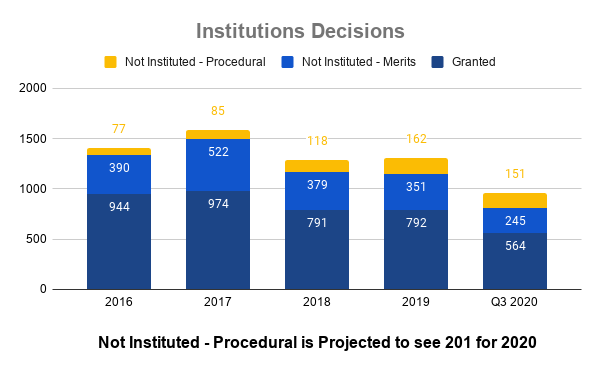
Following Unified’s Quarter 1 and Quarter 2 reports on PTAB procedural denials, we went back to further analyze and categorize all Board decisions to date to understand the impact of new decisions, including the NHK Spring/Fintiv and General Plastic/NVIDIA line of decisions. This year, the number of non-merits or “procedural” denials by the Board has dramatically increased overall; for example, through the first nine months of 2020, 151 denials (16% of all decisions) have been issued, nearly tying 2019’s 162 denials for the entire year. 

With total number of institution decisions by the Board somewhat depressed overall this year, we now see that the amount of discretionary denials as a percentage of total denials has risen dramatically, representing more than a third of all institution denials in 2020–or put another way, 38% of all denials in 2020 to date are cases where the Board did not consider the merits of the petition.

Institutions Decisions (2).png

In the 151 denials to date in 2020, 314(a) has been the predominant means of procedural denial, used by the PTAB 73% of time (110 total decisions). Meanwhile, 325(d) denials are at their lowest since 2017, with only 27 denials this year. This year has also not seen any “combination” denials under both 314(a) and 325(d).

Procedural Denials (3).png

The reduction in 325(d) denials makes sense on some level, given the overlap between the various 314 analyses (which include analyses of other petitions or forums and the grounds they raised), and with the overlap of the “same or substantially same” grounds already raised by the parties in other IPR proceedings. In those overlapping instances, 314 may be an easier form of denial, whereas application of 325 may be less straightforward, requiring a more prior art-heavy analysis to justify denial. 

Looking at the last five years, 314(a) denials are now used by the Board 9.5% of time, up 2.5% from the last quarter.

§ 314(a) Denials vs All Other Denials (1).png

On the other hand, while § 325(d) denials are at their lowest overall number since 2017 (so far),  they have decreased just .3% from the last quarter, to 5.4% total over the past five years as a percentage of all denials.

§ 325(d) Denials vs All Other Denials (1).png

In 2020 to date, 83% of all procedural denials are denied due to either a parallel petition, the NHK Spring/Fintiv framework, or the General Plastic/NVIDIA framework. Parallel petitions accounted for 40% of (or 44) denials of the 110. NHK Spring/Fintiv framework was used 43% of the time to deny petitions (or 47 denials of the 110 total). Interestingly given that it was the genesis of “discretionary denials” under 314, the General Plastic/NVIDIA framework was used just 13% of the time (or in 14 denials of the 110).

314(a) Denials By Type (3).png

One of the more interesting developments in the analysis used in NHK Spring/Fintiv denials has been the denial of institution based on the Board “estimating” when a trial will be held, even when a trial date has not been scheduled in the District Court. In two recent cases, the Board refused to consider the merits of challenges based on their own estimates of when a trial date was likely to occur, and rejected arguments and speculations to the contrary. 

There has also been a notable reliance on the “cost” and “investment” of the PTAB, the parties, and the Court in their respective proceedings, or the cost or benefit of such respective proceedings, without any substantive economic analysis of actual economic cost to any party or institution, or a reliance on any data whatsoever to support a cost (or benefit) to the parties or decision makers. The lack of any economic support for economic assumptions made by the agency is notable, given that economic efficiency is one of the primary grounds advanced by the agency on which such denials are based.  

For questions, comments, or inquiries, please contact info@unifiedpatents.com

Click to download the full report.

Footnotes

  1. PTAB/District Court Trial Date Denials Spiraling Upward: Discretionary PTAB Denials Third-Quarter Report by Unified Patents, LLC is licensed under a Creative Commons Attribution 4.0 International License.  Sharing, reproduction, and adaptation are permitted in commercial contexts with proper attribution.

  2. Unified Patents, PTAB Procedural Denials and the Rise of § 314 (May 13, 2020), https://www.unifiedpatents.com/insights/2020/5/13/ptab-procedural-denial-and-the-rise-of-314.

  3. Unified Patents, PTAB Discretionary Denials: In the First Half of 2020, Denials Already Exceed All of 2019 (July 27, 2020), https://www.unifiedpatents.com/insights/2020/7/27/ptab-discretionary-denials-in-the-first-half-of-2020-denials-already-exceed-all-of-2019.

  4. We refer to “procedural denials” as any denial of institution where the substantive merits of the petition were not considered in light of policy-based decision making or “discretion.” Some discretion is directly spelled out in the statute–for instance, 35 U.S.C. 325(d) tightly circumscribes and explicitly grants the Director the ability to “determine the manner in which the post-grant review or other proceeding or matter may proceed, including providing for the stay, transfer, consolidation, or termination of any such matter or proceeding.”  Joinder discretion is made explicit under 35 U.S.C. 315(c): “the Director, in his or her discretion, may join as a party to that inter partes review any person who properly files a petition ... that the Director ... determines warrants the institution of an inter partes review under section 314.”  Meanwhile, 35 U.S.C. 314(a) contains no such express grant or outline.

  5. NHK Spring Co. v. Intri-Plex Technologies, Inc., IPR2018-00752, Paper 8 (PTAB Sept. 12, 2018) (precedential); Apple Inc. v. Fintiv, Inc., IPR2020-00019, Paper 11 (PTAB Mar. 20, 2020) (precedential).

  6. General Plastic Industrial Co., Ltd. v. Canon Kabushiki Kaisha, IPR2016-01357, Paper 19 (PTAB Sept. 6, 2017) (precedential); NVIDIA Corp. v. Samsung Elec. Co., IPR2016-00134, Paper 9 (PTAB May 4, 2016).

  7. For the sake of simplicity and because it was more difficult to code for and not explicitly tied to a particular precedential decision, we placed the July 2019 Trial Practice Guide Update line of cases (i.e., the “parallel petition” denials based on ranking of petitions) with the General Plastics/NVIDIA line of cases.  We will continue to refine the data to provide the most accurate picture possible as we produce future reports.  If you have inquiries about methodology or the data or reports themselves, please contact PatentQualityInitative@unifiedpatents.com.

  8. The remaining 5 denials amounted to another 4.5% of all denials, for various reasons.

  9. Intel Corp. v. VLSI Technology, LLC, IPR2020-00583, Paper 22 (PTAB Oct. 5, 2020); Supercell Oy v. GREE, Inc., PGR2020-00053, Paper 12 (PTAB Oct. 9, 2020).

Copyright © 2020, Unified Patents, LLC. All rights reserved.